






Revolutionize Your Business With AI-Powered ERP
Turn Your Data into a Competitive AdvantageIf your organization is still using its ERP system the same way it did a decade ago, you’re likely missing out on significant opportunities. Traditional ERP platforms excel at storing data, managing orders, and maintaining operational structure—but they were not designed to identify emerging trends, generate predictive insights, or guide strategic decisions. That’s precisely where artificial intelligence (AI) transforms the equation.
Think of AI-enhanced ERP as an evolution that converts your existing system from a passive reporting tool into an active decision-making engine. By learning patterns across inventory, sales, workforce dynamics, supply chain logistics, and customer behavior, it enables proactive action before challenges escalate.
In the following sections, we’ll explore:
- What AI-powered ERP System looks like in practical application
- Real-world AI use cases – Generative, Predictive, Agentic AI
- MDTS Service Offerings
- The AI-Powered ERP Adoption Maturity Model
- Top AI-Powered ERP Vendors (2025-2026)
What AI-Powered ERP System Looks-Like In Practical Application
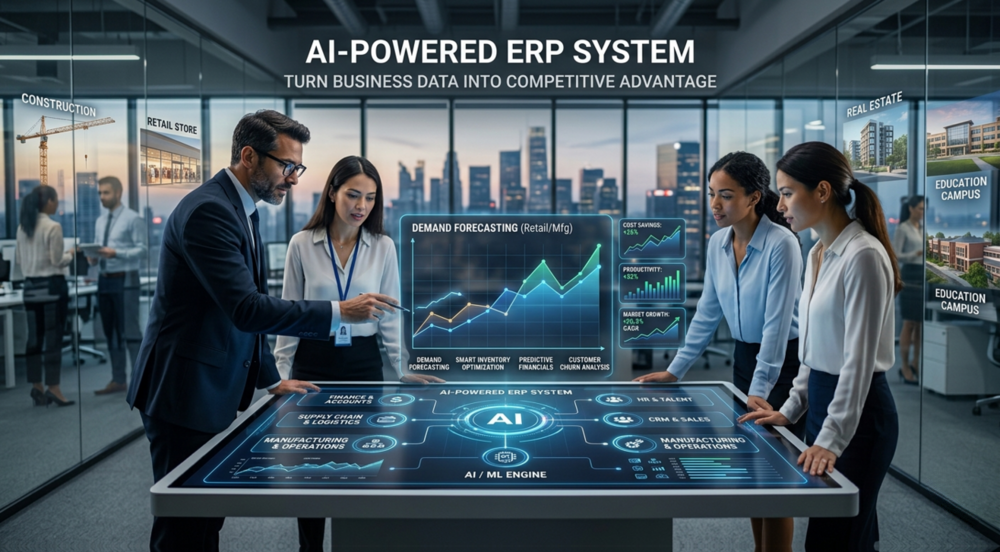
In practical terms, AI-powered ERP represents the next generation of business management software, integrating artificial intelligence (AI), machine learning (ML), natural language processing (NLP), and predictive analytics directly into core workflows. Unlike traditional systems that act as static “systems of record” requiring manual data entry, these intelligent platforms function as dynamic “systems of action”—analyzing data patterns in real time to automate tasks, forecast demand, surface actionable insights, and even execute decisions autonomously. This convergence of AI and automation empowers finance, human resources, supply chain, and operations teams to move beyond reactive, manual workflows. The result is a fundamental shift: organizations can redirect focus from administrative “blocking and tackling” to strategic initiatives such as workforce vitality, financial forecasting, and customer experience, driving greater efficiency, agility, and competitive advantage in today’s fast-paced business environment. Here’s what that means in day-to-day operations:
Before AI-Powered ERP (Traditional ERP)
-
A manager reviews last month’s sales report to decide what inventory to order
-
Finance staff manually match invoices to purchase orders
-
HR responds to repetitive employee questions about policies
-
Maintenance teams wait for equipment to break before scheduling repairs
After AI-Powered ERP (New ERP Reality)
-
Real-Time Predictive Insights: The system forecasts demand for the coming week based on current trends, weather patterns, and supplier lead times, automatically suggesting purchase orders.
-
Intelligent Automation: Invoices are matched, approved, and processed without manual intervention. Exceptions are flagged for review, but routine transactions happen autonomously.
-
Conversational Assistance: Employees ask a natural language chatbot questions like “How many vacation days do I have left?” or “What is the approval status of PO #1234?” and receive instant answers.
-
Proactive Alerts: The system detects a potential cash flow shortfall two weeks in advance and notifies the finance team with recommended actions.
-
Predictive Maintenance: Sensors on manufacturing equipment feed data into the ERP, which predicts failure risk and schedules maintenance before a breakdown occurs—preventing costly downtime.
The Shift in User Experience
-
From Data Entry to Exception Management: Instead of manually entering transactions, users spend time reviewing and acting on system-generated recommendations and alerts.
-
From Searching to Surfacing: Information comes to users through intelligent dashboards and proactive notifications rather than requiring them to run reports and dig for answers.
-
From Reactive to Proactive: The system identifies issues—like declining customer engagement or inventory imbalances—before they become problems, enabling timely intervention.
Real-World AI Use Cases - Generative, Predictive, Agentic AI
When we discuss AI in ERP, we are not referring to vague automation concepts or distant possibilities. We are describing tools that organizations are using today to solve tangible challenges across industries. Across virtually every industry, AI-powered ERP is delivering transformative value through a set of increasingly standardized use cases that address universal business challenges.
What unites these diverse applications is a common thread: AI-powered ERP is moving organizations from reactive, manual operations to intelligent, automated workflows that predict, recommend, and act—delivering faster decisions, lower costs, and a sustainable competitive advantage regardless of industry.
Need help to build, scale, and integrate AI capabilities without disrupting existing operations. Book an appointment with us today.
MDTS - Service Offerings
Two Paths to AI-Powered ERP. Only One Leads to Success.
with MDTS (your Trusted Partner)
Thinking about AI for your ERP? Don’t settle for a vendor without advice.
Partner with MDTS for a comprehensive, end-to-end AI-powered ERP delivery– from strategy to adoption. We align AI with your business goals, not the other way around. No handoffs. No runaround.
Just one Trusted Partner who ensures your new system is selected well, designed, configured, integrated, and adopted for real success. Choose MDTS. Stay in control.
-
Build a Transformation Framework: Develop “Phase 0” readiness plan that prioritizes data quality, stakeholder alignment, and future-state operating models before implementation begins.
-
Assess Your Current State: Evaluate your legacy systems, data readiness, and operational maturity against our AI-Powered ERP Adoption Maturity Model .
-
Define Your Future State: Align your business goals with the right AI capabilities, whether it’s predictive budgeting, supply chain optimization, or intelligent HR processes.
-
System Installation & Configuration: Seamless setup of your chosen cloud ERP platform.
-
Data Migration & Quality Assurance: Clean, structured data is the foundation of AI. We manage complex data conversion processes with a focus on compliance and security.
-
Intelligent Workflow Automation: Design and deploy AI-driven workflows for finance, HR, supply chain, and operations.
-
Custom Integration: Connect new ERP with other systems, collaboration apps, and service delivery models to create a unified user experience.
-
Testing & Quality Assurance: Ensure system reliability, performance, and user readiness before go-live.
- Cutover & Go-Live: Assure delivery of system to Production
-
Support , Customer Care & Innovation: We stay with you every-step-of-the way.
with a software Vendor
Not ready for full transformation? Let us help you choose the right path first. Our advisory services ensure your transformation is driven by strategy, vision, and long-term goals – not just technology. We help you define a business roadmap for your AI ERP transformation and select the right ERP Vendor/ Delivery Partner.
-
Build a Transformation Framework: Develop a “Phase 0” readiness plan that prioritizes data quality, stakeholder alignment, and future-state operating models before implementation begins.
-
Assess Your Current State: Evaluate your legacy systems, data readiness, and operational maturity against our AI-Powered ERP Adoption Maturity Model (from Ad Hoc to Autonomous).
-
Define Your Future State: Align your business goals with the right AI capabilities, whether it’s predictive budgeting, supply chain integration, or intelligent HR processes.
-
Choose a Vendor: Navigate the complex landscape of top AI ERP vendors to find the perfect fit for your industry, size, and strategic objectives. ERP Innovators List 2026.
Then, when you’re ready, we can step into the full transformation partnership — or you can take our roadmap to a vendor of your choice. Either way, you move forward with clarity, not confusion.


The AI-Powered ERP Adoption Maturity Model
A successful transformation is a journey. At MDTS Consulting, we guide you through the five stages of AI-ERP maturity to ensure you don’t just adopt technology, but achieve tangible business outcomes:
- Initial (Ad Hoc): Fragmented landscape, manual processes, and siloed data. Focus: Awareness and initial exploration.
- Opportunistic (Experimenting): Early AI pilots (e.g., chatbots, fraud detection) are launched. Focus: Proving value and building internal knowledge.
- Integrated (Defined): AI is embedded into daily operations. Data governance and MLOps are matured. Focus: Scaling pilots to production for actionable insights.
- Intelligent (Systemic): AI-driven decisions are common, with widespread automation across departments. Focus: Enhancing operational efficiency.
- Autonomous (Transformational): ERP systems are self-optimizing. AI acts as a driver for new business models, such as supply chains that self-adjust without human intervention. Focus: Strategic innovation.
Top AI-Powered ERP Vendors (2025-2026)
| Criteria | SAP S/4HANA Cloud | Microsoft Dynamics 365 | Oracle Cloud & NetSuite | Infor Cloud Suite | Epicor Kinetic | Acumatica | Sage Intacct | Workday | Deltek |
|---|---|---|---|---|---|---|---|---|---|
| 🏢 Best for industry | Large global enterprises with complex, industry-specific needs | Teams already using Microsoft tech stacks (Office 365, Azure) | Enterprises seeking robust financial management and mid-market, high-growth companies | Companies in manufacturing, distribution, and healthcare needing specialized tools | Manufacturers looking to solve complex shop floor challenges | Mid-market companies requiring flexible, customizable AI solutions | Professional services, non-profits, and finance-focused organizations | Organizations prioritizing HR transformation and employee experience | Professional services firms (architecture, engineering, consulting) |
| 🤖 AI feature | Deep functional breadth, SAP Business AI (Joule assistant), strong manufacturing capabilities | Copilot integration for AI-driven automation, predictive insights, unified ecosystem | Predictive analytics, automated procurement, financial forecasting, NetSuite cloud AI | Industry-specific micro-verticals, Coleman AI Suite for demand forecasting & inventory | AI-driven quality control, predictive maintenance, supply chain optimization, Prism gen AI | Open architecture for high customization, NLP, AI-driven warehouse automation | Strong financial AI automation, intelligent time tracking, deep service industry functionality | Cloud-native HCM & financials, user-centric AI for talent management & workforce planning | Specialized AI for project-based businesses |
| ⏱️ Implementation time | 6-18 months | 3-6 months | 4-12 months | 6-12 months | 4-8 months | 3-6 months | 3-5 months | 3-9 months | 4-8 months |
| 💰 Pricing model | Complex (contact sales) | Per user/month | Per user/month (both) | Varies by industry | Per user/month | Per user/month | Per user/month | Per user/month | Project-based |
| ⚙️ Customization | Very high | High | Medium | High | Medium | Very high | Medium | Medium | High |
| 🛠️ Support quality | Good | Excellent | Good | Good | Good | Good | Excellent | Excellent | Good |
Note: This list represents leading vendors as of 2025-2026. The “right” vendor depends on your industry, size, existing tech stack, and strategic goals. MDTS offers independent vendor selection advisory to help you navigate these options without bias.
Unlock Your ERP's Potential with AI
Ready to transform your business? Contact us today to discover how our AI-powered ERP modernization services can drive efficiency and strategic growth. Let MDTS Consulting guide you on your journey to an intelligent, agile enterprise.